
A Structural Imbalance: 30,000 Brokers, Three Listing Slots
Dubai's regulatory framework limits each property owner to a maximum of three active listing agreements at any given time.
This rule improves accountability. It reduces duplication and protects owners from uncontrolled listing inflation.
But when placed against a brokerage population approaching 30,000 professionals, it creates a structural imbalance.
Even in a fully compliant market, only three brokers can hold a formal mandate for a unit at once.
The remaining tens of thousands must rely on cooperation.
That reality explains why off-market distribution is not an exception in Dubai. It is a necessity.
The competition to secure listing mandates is intense. Even brokers who already have qualified buyers cannot realistically expect to hold formal mandates across every relevant unit.
In such an environment, access, not exposure, becomes the real constraint.
Commission Clarity Shapes Participation
In a saturated broker market, prioritization is inevitable.
Typical brokerage fees in Dubai hover around 2 percent of the sale price. The exact percentage is secondary to one factor: whether the commission is clearly defined, seller-backed, and stable from the outset.
When commission terms are transparent and protected, brokers allocate effort confidently. They bring serious buyers without hesitation. They invest time knowing their participation is secure.
When commission terms are informal, uncertain, or renegotiated mid-process, distribution narrows. The property competes against others with clearer frameworks.
In a market where billions of dirhams in commissions are generated within months, clarity directly influences how agents prioritize their time.
This is not about motivation. It is about structure.
The Limits of Informal Off-Market Cooperation
Because listing slots are limited and broker participation is high, much of the secondary market operates through off-market collaboration.
Off-market access, however, often lacks consistency at scale.
Availability changes without structured updates. Commission discussions are revisited mid-process. Information fragments across conversations. Attribution becomes unclear.
As participation grows, informal coordination becomes harder to sustain. With nearly 30,000 brokers competing in the same ecosystem, even small ambiguities create hesitation.
And hesitation, at scale, slows the market.
Scaling Cooperation Without Expanding Listing Slots
The structural question becomes clear.
If owners are limited to three listing mandates, and tens of thousands of brokers compete for access, how can cooperation scale without increasing regulatory complexity?
The answer is not to expand listing contracts.
It is to centralize mandate management and scale access responsibly.
When an owner delegates representation through a structured intermediary model, that mandate can be coordinated centrally, while distribution is extended to a broader broker network under consistent, defined terms.
In this format:
The owner remains compliant with listing limits. Commission terms are defined upfront. Information is centralized and current. Participation is widened without mandate duplication.
Access is expanded without compromising structure.
Democratizing Access Within a Structured Framework
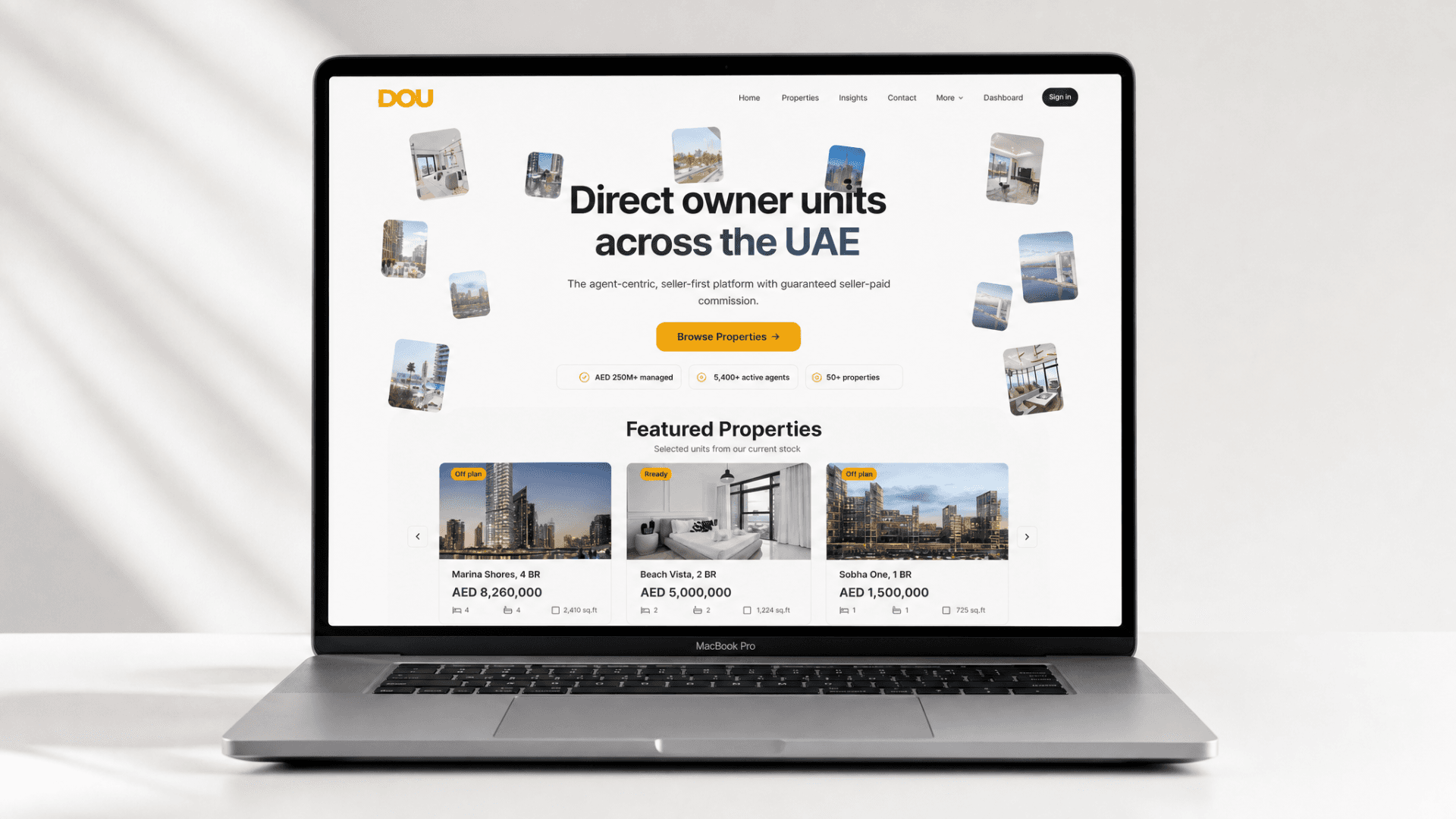
At DOU, this is precisely the model being built.
Owners delegate coordination to a centralized distribution layer. Commission terms are defined and protected before a unit is introduced to the network. Information is verified and maintained. Viewing processes are organized.
From the broker's perspective, this creates an experience similar to holding a secure listing, without requiring a formal mandate slot.
At present, the DOU community includes 8,200+ agents. As the network grows, access scales while remaining compliant with existing regulatory frameworks.
The objective is not to bypass listing limits. It is to make cooperation scalable.
In a market with nearly 30,000 brokers competing over limited mandate slots, widening structured access improves execution efficiency for everyone involved.
Strengthening the Broker-Driven Market
Dubai's secondary market runs on broker cooperation. That foundation will not change.
What can change is how efficiently that cooperation is supported.
As broker participation rises and transaction volumes remain strong, informal systems struggle to keep pace.
Structured, centralized coordination with clear commission terms, consistent information, and broad but organized access reduces the distribution bottleneck without expanding regulatory burden.
The market does not lack exposure.
It lacks scalable coordination.
And in a competitive, broker-driven ecosystem generating billions in commissions each half-year, that distinction defines the difference between visibility and execution.